Seedance 2.0 Prompts: How to Write AI Video Prompts That Actually Work
Varga Mihaly
Prompt Engineer
If you've generated a cinematic AI video recently, there's a good chance Seedance 2.0 did the heavy lifting behind the scenes. It's one of the newest AI video models on the market, and it's quickly become one of the most capable, especially for creators looking to maintain multi-reference control across shots, camera movements, and character styling.
Here is what Seedance 2.0 is, why it matters for AI filmmaking, and how to write structured prompts to get consistent, high-end cinematic outputs every single time.
What is Seedance 2.0?
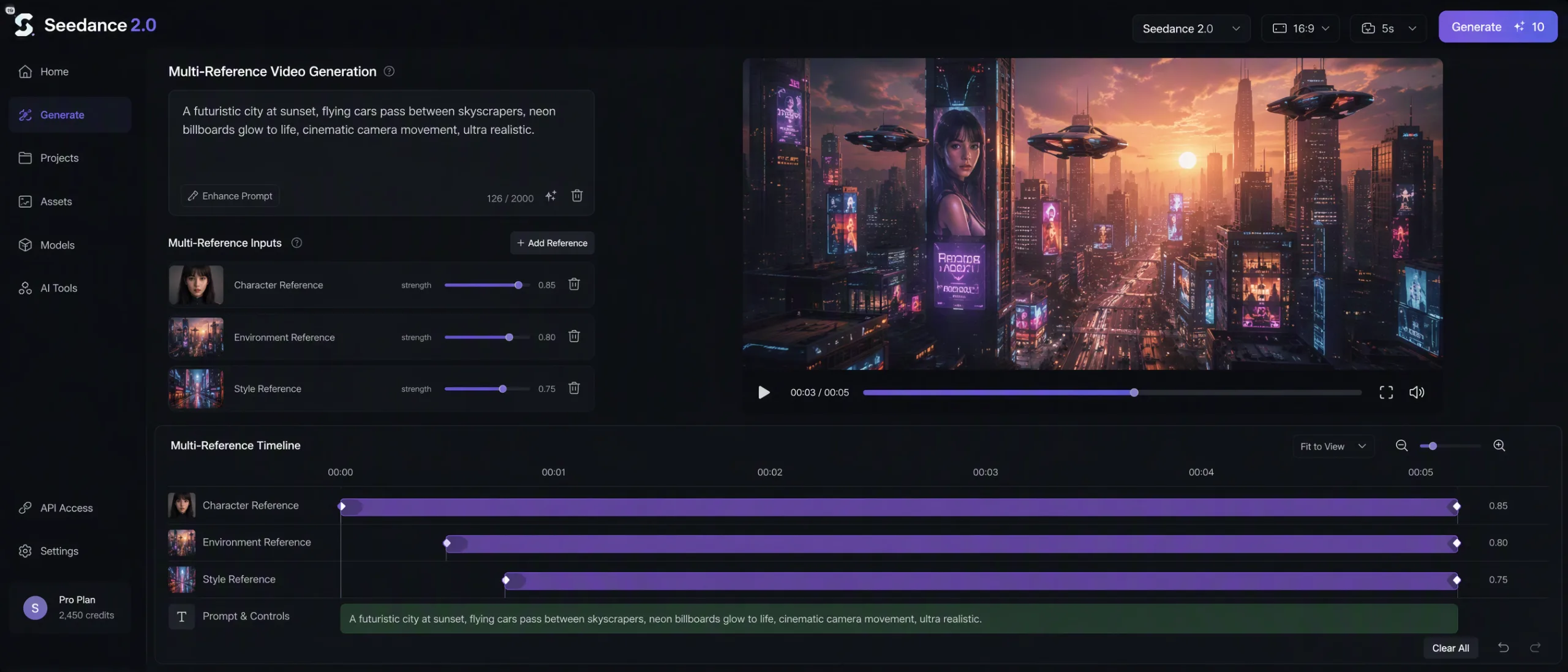
Seedance 2.0 is ByteDance's flagship video generation model, released in early 2026 as a major upgrade over the original Seedance. Where most AI video tools take a single text prompt or a single reference image, Seedance 2.0 was built to handle multiple inputs at once and weave them into one coherent shot.
In practice, that means you can hand it a start frame, an end frame, a reference clip for motion style, and a piece of audio, and it will combine all of that into a single continuous shot. That's a0 meaningfully different approach from older single-input models, which could only work from one anchor point at a time.
Why it's a good fit for cinematic AI filmmaking
Cinematic storytelling requires visual continuity — maintaining character faces, specific lighting setups, and camera movement trajectories from shot to shot. Seedance 2.0's multi-reference architecture prevents character morphing and style drift, making it the premier choice for narrative short films and high-budget visual effects sequences.
What this means for you as a creator
You don't need to understand the underlying neural network architecture to benefit from it. Once you master the 3-layer prompt structure Seedance responds to, you can reliably control camera lenses, lighting ratios, and complex movement choreography in a single pass.
How to Write Seedance 2.0 Prompts (Structure & Examples)
A strong Seedance 2.0 prompt isn't just a description — it's a shot plan. The model responds best when you give it camera movement, lighting behavior, and texture detail in the same breath as the action itself, rather than a vague single sentence.
A typical Seedance 2.0 prompt has three layers:
- Technical/Style Header: Shot type, lens behavior, camera rig, and lighting aesthetic (e.g., ARRI ALEXA, 35mm film grain).
- Scene Description: Subject details, actions, environment, and visual atmosphere.
- Camera Choreography Block: Beat-by-beat timing, lens movement, and explicit constraints on what the camera does (and does NOT) do.
Common mistakes when writing Seedance 2.0 prompts
Most creators either write prompts that are too vague ("a car chase through a city at night") or too cluttered with contradictory instructions. Seedance 2.0 rewards specificity and consistency, one clear camera path, one lighting condition held throughout, and texture cues that match the shot's scale (macro vs. wide).
Write Seedance Prompts Faster Using a Claude Skill
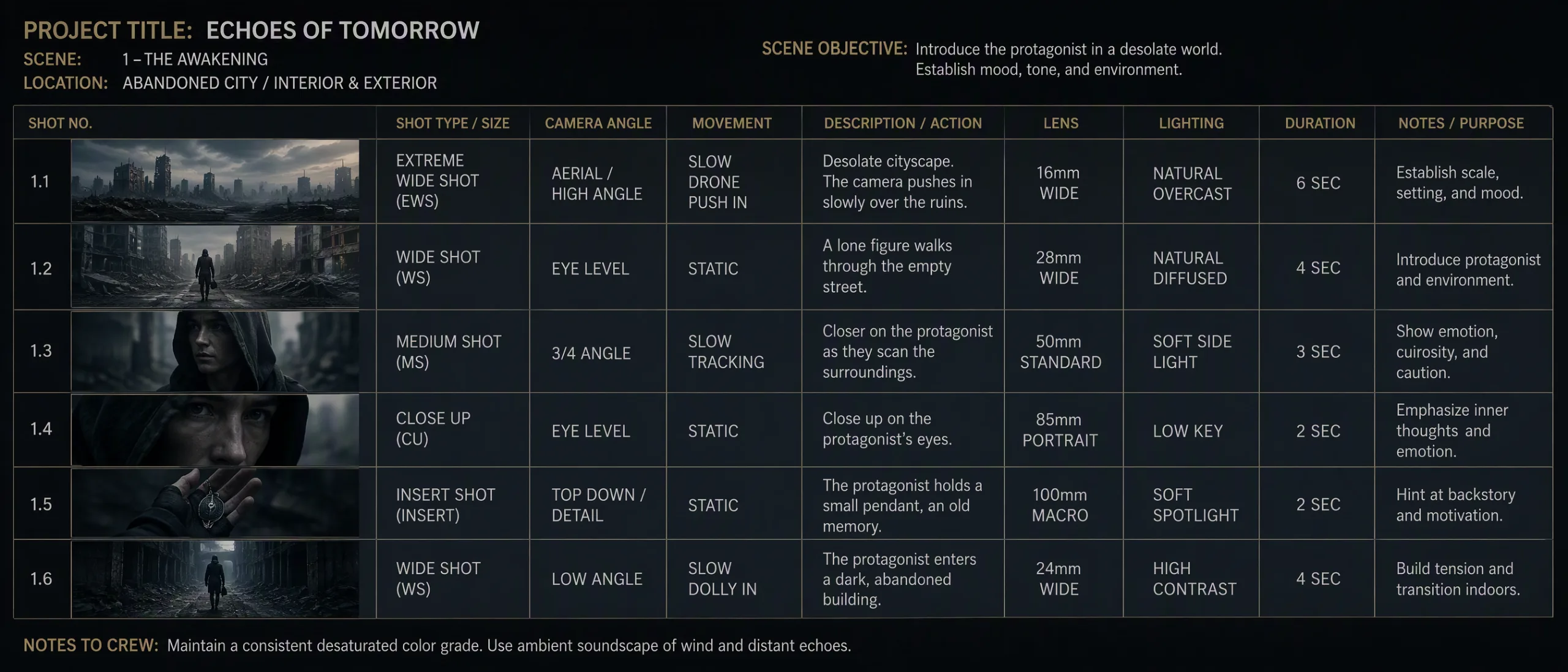
Writing a full Seedance prompt by hand technical header, scene description, shot-by-shot camera choreography, SFX layer, takes time to get right. A faster approach: use Claude with a custom Seedance Prompt Builder Skill, which turns a plain-English brief into a fully structured, generation-ready Seedance prompt in one pass.
Instead of writing "a warrior fighting a monster" and hoping for the best, you describe your scene in normal language — characters, setting, mood, roughly how long it should be — and the Skill expands it into the full technical format Seedance responds to: cinematography header, lighting and color ratios, camera lens behavior, subject tags, shot-by-shot timing, and audio cues.
What the Skill handles for you
- Cinematography header (lens type, shutter behavior, speed-ramping, stabilization style)
- Lighting and color ratio breakdown (dominant / secondary / accent, in percentages)
- Subject tags for consistent character/object reference across a multi-shot sequence
- Beat-by-beat shot timing (0:00–0:04, 0:04–0:05, etc.) instead of one run-on paragraph
- Audio layer written separately from the visual action, matched to each beat
- Explicit camera constraints (what the camera does NOT do — critical for POV and one-take shots)
This matters because the difference between a prompt that "sort of works" and one that nails the shot is almost always structure, not creativity. The Skill enforces the structure every time, so you can focus on the idea instead of remembering the format.
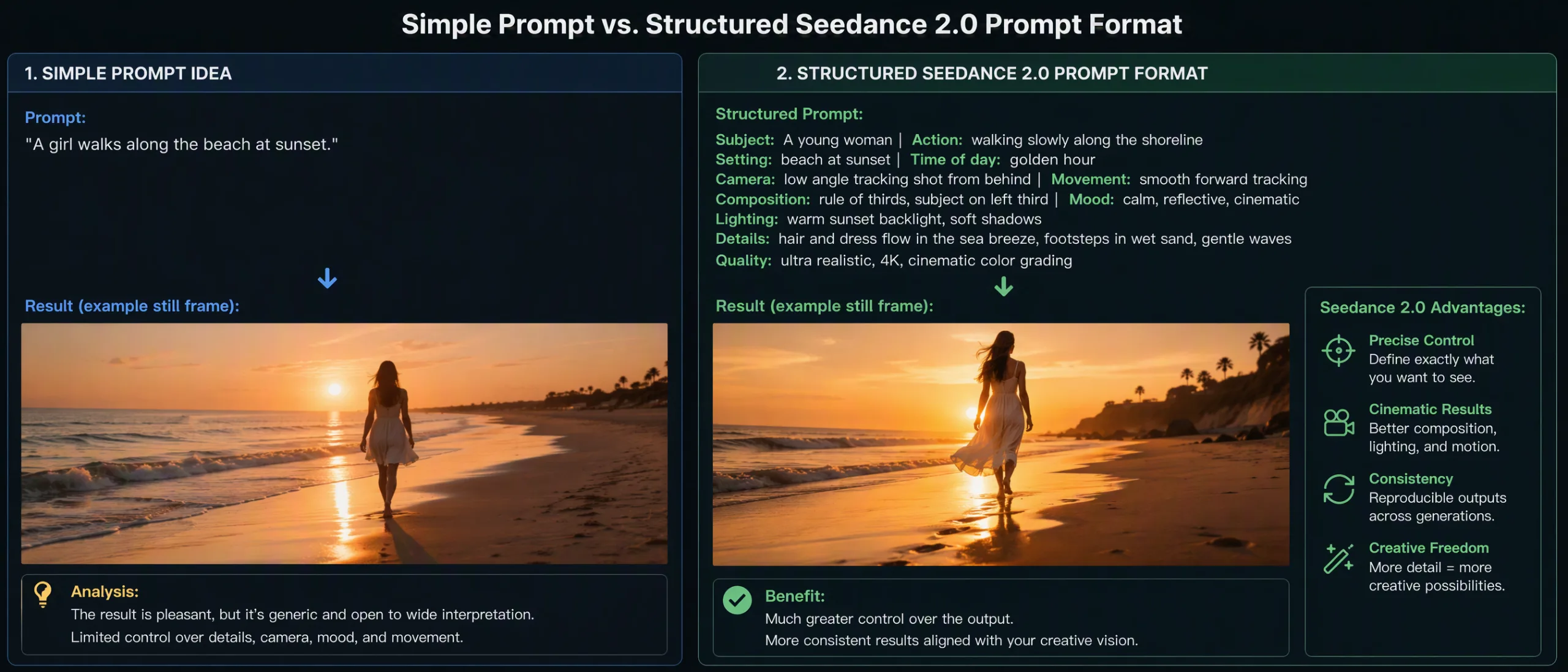
Seedance 2.0 Prompt Formats: The Complete Breakdown
Seedance 2.0 prompts aren't one-size-fits-all. The structure changes depending on what you're building — a transformation sequence needs numbered shots and an escalation arc, while a POV shot needs the opposite: one continuous take with explicit instructions about what the camera does NOT do. Below is every format that consistently works, broken down by structure, with a full example for each.
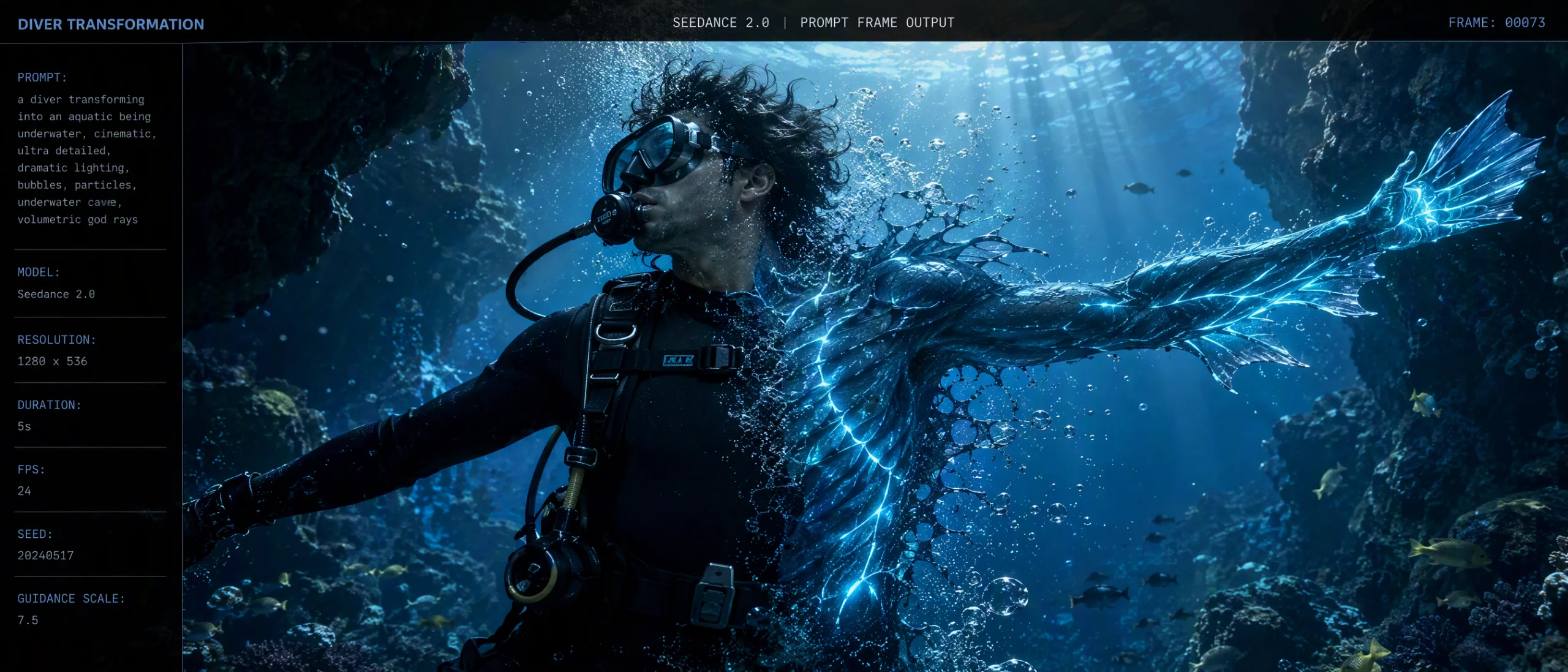
Format 1: Transformation Prompts
Transformations are the highest-performing Seedance 2.0 format. Write each shot individually, number them, and build a clear escalation arc: calm → threat → transformation → aftermath. Vague single-paragraph prompts fall apart here — Seedance needs the beat-by-beat shot list to hold the sequence together.
Example: The Diver a free-diver descending into a coral reef trench transforms mid-dive into a bioluminescent sea creature to escape a pursuing shark, then resurfaces as human. 6 shots, 15 seconds.
“Montage, multi-shot underwater action sequence, don't use one camera angle or single cut, cinematic lighting, photorealistic, 35mm film quality, professional color grading, sharp focus, high detail texture, film grain, depth of field mastery, ARRI ALEXA aesthetic A free-diver in a black wetsuit descends through a sunlit coral trench, kicking calmly past schools of fish. A large shark emerges from the trench's shadowed depths and begins pursuit. The diver's body erupts into a translucent bioluminescent sea creature with flowing fins and glowing blue veins, evades the shark in a burst of speed, then reverts to human form just before breaking the surface, gasping calmly into daylight. Handheld underwater camera drift throughout, tension building to explosive escape, resolving into calm. Shot 1: Wide shot of the diver descending through sunbeams piercing the trench, calm controlled kicks, coral and fish drifting past. Camera drifts gently with the current. Shot 2: Medium shot from below as the shark's silhouette appears at the trench mouth, gliding into frame with slow deliberate movement. Camera tilts up, tracking the threat. Shot 3: Close-up on the diver's mask as they notice the shark, eyes widening behind the glass, bubbles releasing in a sharp exhale. Shot 4: Medium shot as the diver's body dissolves into light and reforms into the bioluminescent creature, fins unfurling, glowing veins spreading across a translucent body. Camera shakes with the transformation's energy pulse. Shot 5: Wide low-angle as the creature rockets past the shark in a spiral burst of blue light, the shark snapping at empty water. Camera whips to follow the streak of light. Shot 6: Medium shot as the creature dissolves back into the diver just below the surface, who breaks through into daylight, pulling off the mask, breathing calmly, floating on gentle waves. Total: 15s / 6 shots / 16:9”
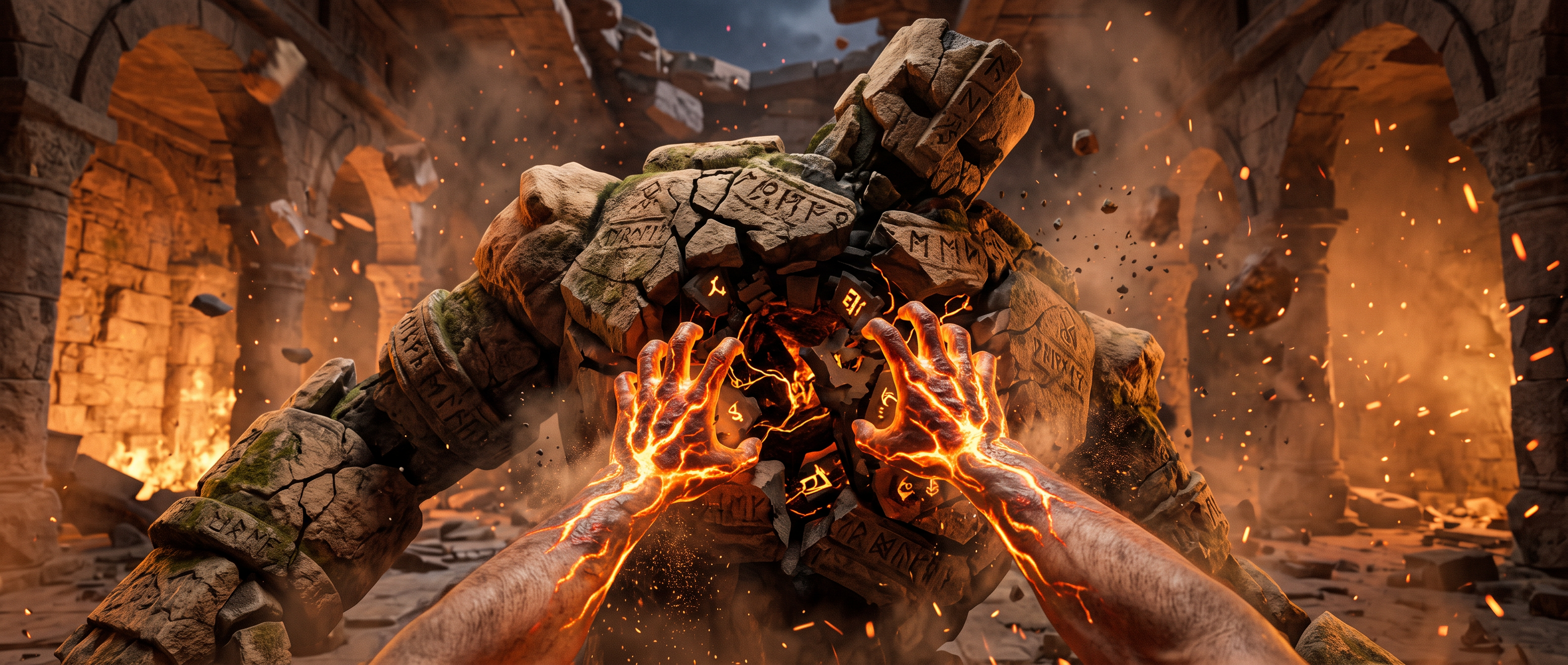
Format 2: Orb Prompts (Single-Shot POV Power Fantasy)
Orbs are single continuous POV shots where the camera is the character's eyes. The formula: one shot, first-person perspective, hyper-chaotic handheld motion, 15 seconds. What changes between orb prompts is the power, the environment, and the enemy — the camera language stays constant. Specify VFX inline using bracket notation, e.g. [VFX: branching electric circuits pulsing with white-blue current], so Seedance knows exactly what a power looks like on the character's body without breaking the action description.
Example: Ember first-person POV of a character with fire powers fighting through a collapsing desert temple, culminating in destroying a colossal sand golem by igniting its core. Single continuous shot, 15 seconds.
“Single continuous shot, first-person POV perspective, the camera IS his eyes, hyper-chaotic handheld motion, completely unstabilized, violent raw human movement, constant micro-jitters, aggressive head swings, abrupt jerks, frequent over-rotation and harsh correction, wide-angle lens (strong distortion), subtle chromatic aberration near frame edges, 15 seconds, his hands always visible in frame, no music only raw SFX, cinematic lighting, photorealistic, grounded realism, strong 35mm film look, heavy film grain, ARRI ALEXA aesthetic, practical VFX feel, minimal CGI look Inside a collapsing desert temple, his hand grips a cracked stone pillar radiating heat, the surface glowing orange beneath his palm — he pulls, and fire erupts along both forearms in branching molten veins [VFX: cracked-lava-like fissures spreading across skin, embers lifting off in a slow drift], the chamber shudders as sand pours from cracks in the ceiling, a colossal golem made of compacted sand and buried stone tablets rises from the floor, its chest hollow and dark. He sprints forward — first strike, he punches through a collapsing pillar to clear his path, stone shattering into dust. Second attack, he leaps onto a falling slab riding it toward the golem's shoulder, fire trailing behind each footstep. The golem swings a massive fist — he ducks under it, sliding across the sand floor, momentum carrying him beneath its legs. He reaches the golem's hollow chest cavity, plunges both burning hands inside — RAMPS TO SLOW MOTION as fire spreads through the golem's sand body in branching cracks of light, the whole structure beginning to glow from within — SNAPS BACK — the golem detonates outward in a wave of burning sand and stone fragments, the temple ceiling collapsing behind him as he sprints toward a shaft of daylight, both hands still burning, looking back at the temple crumbling into a pillar of fire and dust. SFX: cracking stone, deep heat hum, ember crackle, sand pouring, golem groan rising, footstep impacts, fire whoosh trailing, stone shattering, slow-motion fire spread hiss, core ignition rumble, explosive detonation, collapsing ceiling roar, sprinting footsteps, distant rumble fading Total: 15s / 1 shot / 16:9”
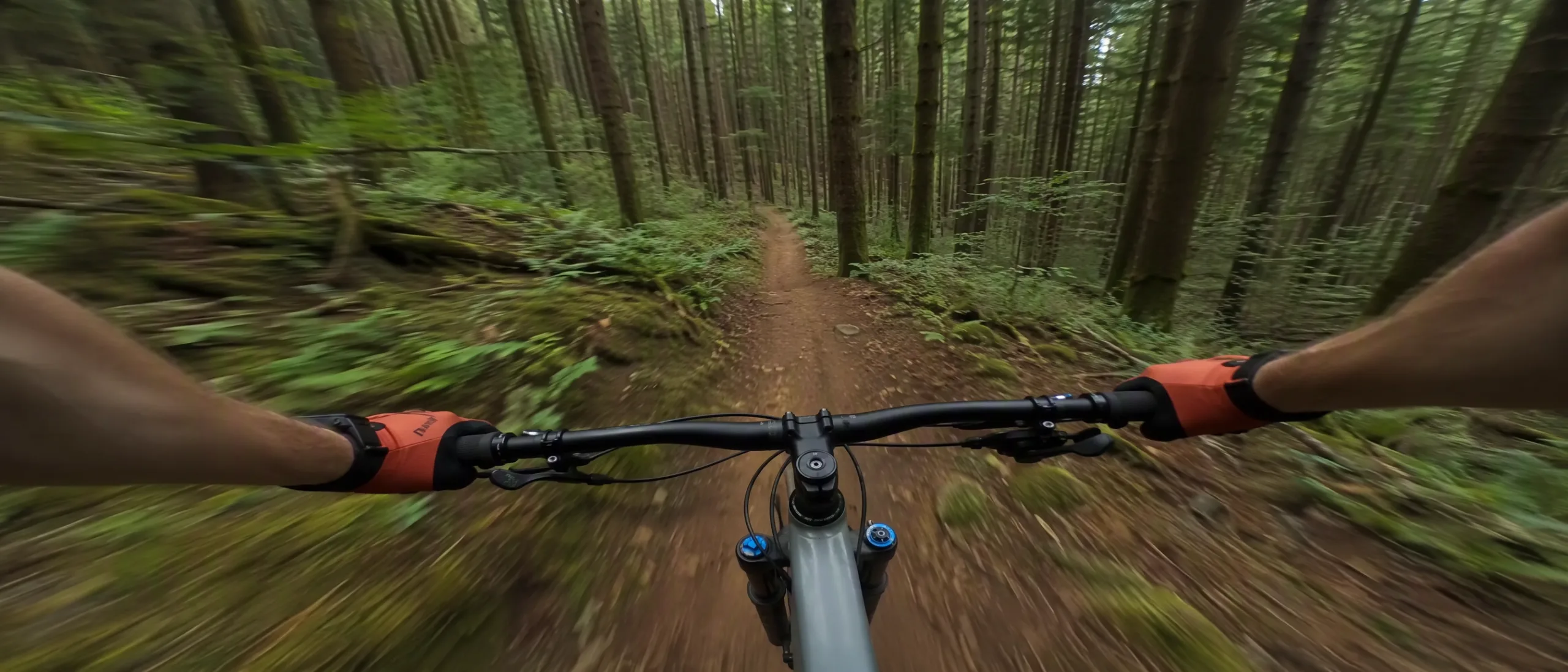
Format 3: POV Prompts
POV prompts live or die on one instruction most people skip: telling Seedance what the camera is NOT doing. "No cuts, no zoom, natural head movement" is what keeps the perspective locked without it, Seedance defaults to cutting between angles and the first-person illusion breaks immediately.
Example: Storm Chaser — first-person perspective of a storm chaser sprinting toward a tornado to plant a data probe, getting caught in debris chaos, then diving into a storm shelter as the tornado passes overhead. One continuous shot, 15 seconds.
“One continuous shot, POV storm chaser perspective on an open plain, no cuts, no zoom, natural head movement, a massive tornado churns across the horizon growing closer, wind roaring louder with each second, the character sprints directly toward it clutching a metal probe device, dust and debris whipping past the lens sideways, as the tornado's outer wind wall hits, loose branches and dirt clouds slam across the frame, the character plants the probe into the ground, fighting to stay upright against the pull, releases it and pivots hard, sprinting back toward a storm shelter door visible in the distance, debris increasing in size and speed — a piece of sheet metal tumbles past inches from the camera — the character dives through the shelter door as it slams shut behind them, the roar deafening outside, dust settling through cracks of light, heavy breathing, cinematic, photorealistic, ultra detailed, motion blur on debris, dramatic overcast lighting”
Format 4: Fight Prompts
Fight scenes need three things: a clear location, a clear power mismatch, and a defined choreography beat by beat. Describe the exact sequence of moves — not just "they fight" — and Seedance will execute close to what's written, including size-mismatch comedy fights and multi-fighter chaos.
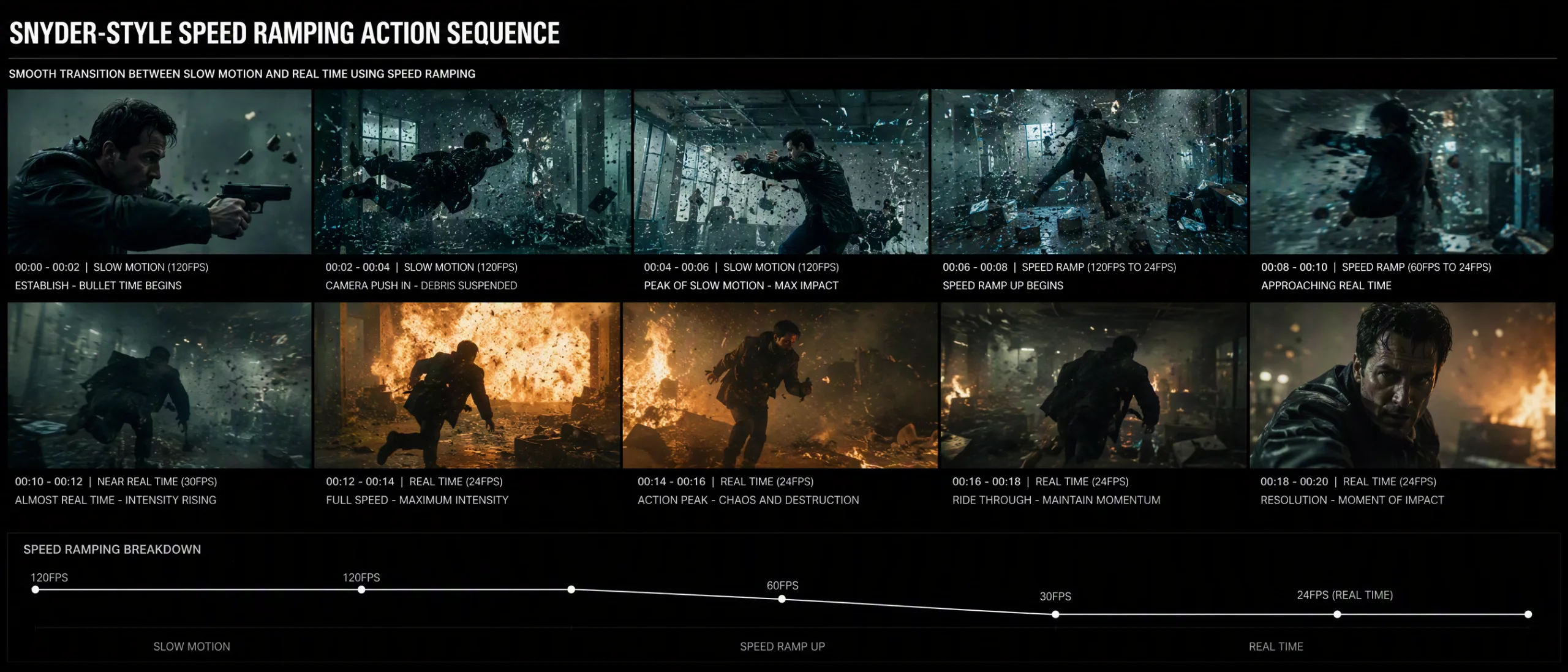
Example: The Rooftop, a courier on a motorcycle is ambushed by two masked attackers on a parking rooftop at night. She fights them off hand-to-hand, then speeds off as the shot ramps back to real time. Single shot, 15 seconds.
“Medium wide shot on a rain-slicked rooftop parking structure at night, neon signage bleeding color across wet concrete, a courier in a leather jacket and helmet parks her motorcycle as two masked figures step out from behind support pillars, one swinging a length of pipe. She ducks the first swing, drives an elbow into his ribs, pipe clattering to the ground, the second attacker grabs her from behind — she drops her weight, flips him over her shoulder onto the wet concrete, he scrambles up and lunges with a knife, RAMPS TO SLOW MOTION as the blade arcs toward her face, she leans back just enough, the blade passing centimeters from her jaw, water droplets suspended in the neon light, SNAPS BACK to full speed as she grabs his wrist, twists, disarms him and drives a knee into his gut, both attackers stumbling back, she sprints to the motorcycle, swings a leg over, engine roaring to life, tires screeching as she peels off toward the rooftop exit ramp, rain streaking sideways in her wake, harsh neon-blue and magenta lighting, wet reflective surfaces, anamorphic 35mm, shallow depth of field, Guy Ritchie speed-ramping with Snyder impact slow-motion Total: 15s / 1 shot / 16:9”
Format 5: Animation Prompts
For stylized/animated output, break the 15 seconds into timed segments (0-3s, 3-6s, etc.) and describe each explicitly. Use a keyframe image as the style reference, state the animation aesthetic in the opening line, and describe physics particle simulation, dust, energy VFX with the same precision as character actions.
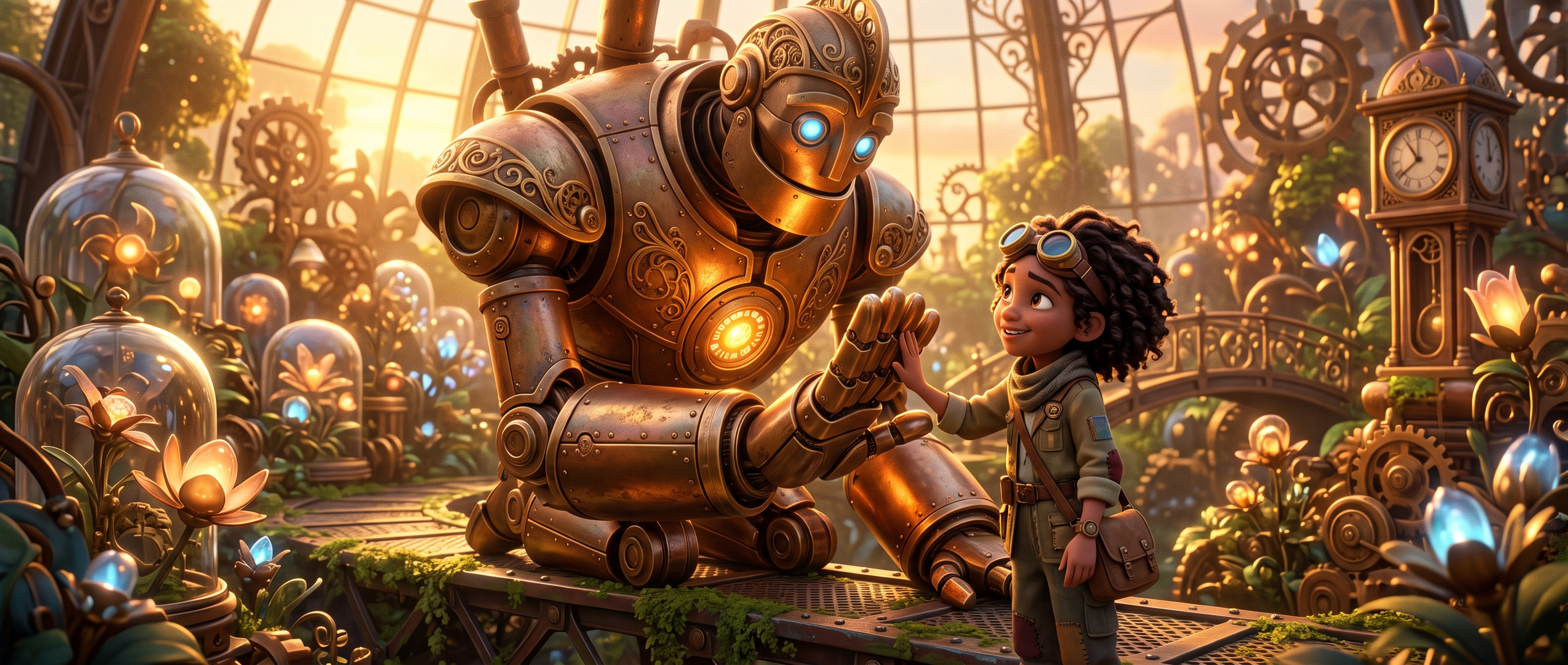
Example: The Clockwork Garden a stylized 3D animated hero navigates a mechanical garden overrun by a colossal malfunctioning clockwork guardian, disabling it not through force but by realigning its broken gears. Single shot, 15 seconds.
“@image is the first keyframe and style reference. Cinematic stylized 3D animation — photorealistic garden environment, stylized character. Hero: young inventor, short auburn hair, brass goggles pushed up on forehead, tan overalls with tool belt, small build — uses precision and intellect over force. Guardian: colossal clockwork automaton — bronze plated body with exposed rotating gears, one arm malfunctioning and spasming erratically, glowing amber core visible through a cracked chest panel, moving with jerky broken rhythm. Setting: an overgrown mechanical garden — brass flower sculptures, moss-covered gears embedded in hedges, golden late-afternoon light filtering through glass greenhouse panels above. High FPS, realistic particle physics for gear dust and steam. 0–3s: WIDE SHOT from @image. Hero approaches cautiously as the guardian's malfunctioning arm swings wildly, smashing a brass flower sculpture. She ducks the debris, studies the guardian's movement pattern, notices the rhythm is broken — not violent, just miscalibrated. She reaches for tools on her belt. 3–6s: She darts between the guardian's swinging arm and its legs, dodging with quick precise footwork rather than confrontation. She leaps onto a rotating gear at its base, climbing the mechanism as it turns, using its own motion to carry her upward toward the chest panel. 6–9s: She reaches the cracked chest panel, glowing amber core sputtering unevenly inside. She pulls a small wrench, reaches into the mechanism — RAMPS TO SLOW MOTION as she carefully realigns a jammed gear tooth by tooth, sparks and steam venting softly around her hands, the guardian's spasming arm slowing — SNAPS BACK as the gear clicks into place. 9–12s: The guardian's entire body shudders, its broken rhythm smoothing into slow, steady mechanical movement. Steam vents evenly from its joints. The amber core in its chest steadies into a warm, constant glow. It lowers its previously flailing arm gently. 12–15s: The guardian kneels down to her eye level, gears whirring softly in a calm rhythm. She pats its bronze hand affectionately. Golden light streams through the greenhouse glass above as the garden's other clockwork flowers begin to bloom again, gears turning in sync. She smiles, wiping oil from her hands on her overalls. Cinematic stylized 3D animation matching @image, photorealistic garden particle simulation, volumetric golden light, steam and gear-dust VFX, realistic brass and mechanical physics, fast dynamic cuts. 2.35:1, 24fps. Total: 15s / 1 shot / 16:9”
What's Next: Seedance 2.5 and Native 30-Second Video
ByteDance previewed Seedance 2.5 in June 2026, with public rollout beginning in early July. The headline change: native 30-second clips generated in a single pass, with no stitching between segments — the current 15-second ceiling on Seedance 2.0 was a hard limit precisely because longer videos required joining separately generated clips, which is where character faces would drift and lighting would shift between segments.
Seedance 2.5 also expands the reference input system significantly up to 50 images, video clips, and audio files in a single generation, up from roughly 15 on Seedance 2.0. For prompt writing, this means multi-character scenes and longer camera choreography sequences become far more reliable, since the model no longer has to guess at continuity across a stitch point.
The prompting principles in this guide — shot structure upfront, explicit camera behavior, escalation arcs, bracket-notation VFX carry over directly to Seedance 2.5. The main adjustment once it's available: you can now write full 30-second shot lists instead of compressing everything into 15 seconds.
Ready-to-Use Seedance 2.0 Prompts
Writing prompts from scratch takes practice — every extra variable (camera path, lighting continuity, multi-reference blending) is a place where a small mistake breaks the shot. If you'd rather skip the trial and error, we've built a growing library of tested, ready-to-use Seedance 2.0 prompts covering cinematic oners, product ads, character sheets, transformations, orbs, POVs, fights, and animation sequences.
Comments
Loading…